








We Are Attending Channel Partners Conference & Expo 2026
April 13-16, 2026 | Las Vegas, NV | Booth #2454


BluIQ is a configurable platform that bridges the gaps between your CRM, ERP and related business processes.

Customize Your Monetization Platform Quickly and Cost-Effectively.

The Ultimate Flexibility and Scalability to Process Complex Data Staging & Mediation Scenarios with Ease

End-to-end Integration for Seamless Order Activation and Provisioning

BluLogix Chargeback & Cost Recovery for Public Sector and Enterprise Organizations

BluIQ gives you reporting, intelligence and insights in one package.

Empowering Ecommerce, Self-Management, and Seamless Renewals with Channel Support


Lessons, observations and insights for the subscription business

How BluIQ helps our customers’ subscription businesses successfully grow

The latest news and analyst reports on the Software-as-a-Service and Subscription industry

Attend an event near you to connect, learn, and gain inspiration.

The best companies in the world trust BluLogix for all of their billing needs

A collection of recorded webinars and videos on Software-as-a-Service and Subscription Management
Details on BluIQ subscription management and billing platform specifications

Subscription and Software-as-a-Service guides with actionable insights

Why Top Companies Choose BluLogix
By David Mink, Director of Public Sector, SOFTRAX + BluLogix
Here is a question worth sitting with: if your agency experienced its largest cloud and AI usage event of the year this month, a major service launch, a filing deadline, a policy announcement that drove ten times normal traffic, could you produce a bureau-level cost attribution report, reconciled against current appropriations, before your next OMB submission is due?
If the answer is no, or if it would take weeks of manual work to get there, that is exactly the gap OMB M-26-10 is designed to surface.
Issued on March 31, 2026 by OMB Director Russell Vought, M-26-10 is not a surprise audit exercise. It is OMB’s formal acknowledgment that the federal government has built decades of procurement infrastructure with almost no consumption intelligence to go alongside it. Agencies know what they contracted for. Most have very little reliable visibility into what they are actually using, what it is costing by bureau and program, and whether they are getting defensible value from it.
M-26-10 is the first formal mandate to close that gap.
M-26-10 has two operative sections, and it helps to understand them separately.
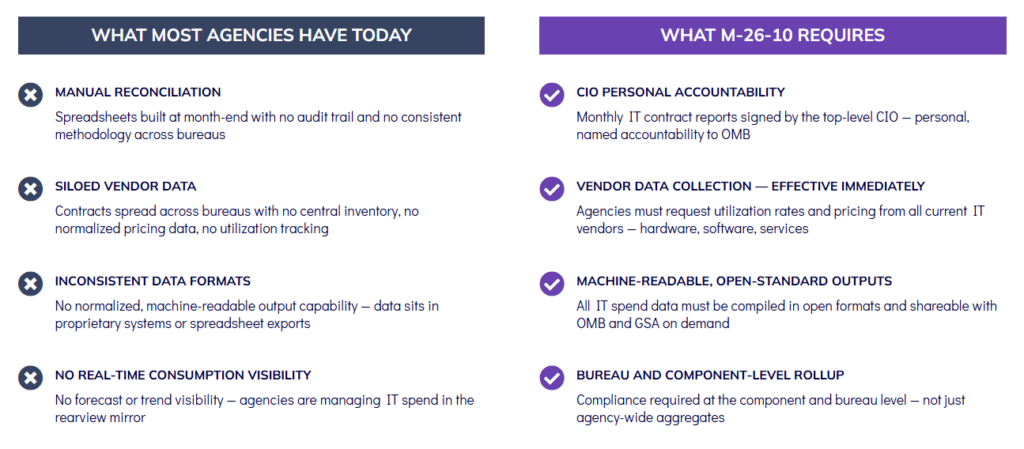
Section 1 requires all 24 CFO Act civilian agencies to report IT contracts to OMB monthly, beginning May 2026. The top-level CIO signs off on every submission. This is a named, personal reporting obligation, not something that can be quietly delegated. Six monthly reports are due through October 2026, with the possibility of extension.
Section 2 is broader and more permanent. Effective immediately, agencies must collect utilization rates and pricing data from all current IT vendors (hardware, software, services, and resellers), compile it in machine-readable, open-standard formats, and share it with OMB and GSA on demand. This is not a one-time data call. It is a structural change to how agencies manage IT acquisition data going forward.
Together, the two sections create a compliance challenge that is less about reporting and more about infrastructure. Most agencies do not have a centralized system that ties IT service consumption to cost centers, normalizes data across vendors, and produces machine-readable outputs on a monthly cycle. Building that capability is what M-26-10 is actually asking for.
The financial models that federal agencies operate were engineered for a fixed-cost, predictable world: annual server contracts, per-seat software licenses, stable headcount. They were not designed for variable cloud consumption, AI workloads that scale with mission demand, or SaaS portfolios that sprawl across bureaus without central tracking.
The result is a structural gap, not an operational one. It cannot be closed by working harder or adding staff. It requires a different kind of data infrastructure: one that ingests consumption data from any vendor, normalizes it across systems, and produces bureau-level, audit-ready outputs automatically.
That is a meaningful undertaking. But it is also a manageable one, if agencies start with the right sequence. The FinOps community has a useful framework for this: showback first, then chargeback. See what is being consumed before you try to bill for it. Build the data foundation before you build the policy. M-26-10 is, at its core, forcing agencies to begin that sequence
M-26-10 has a formal sunset in October 2026. Agencies that treat that as a finish line are misreading the signal. OMB will spend those six months collecting data on which agencies can produce clean, defensible IT cost reports and which cannot. The agencies that struggle in this phase will become the primary targets for more stringent requirements in the next.
FITARA followed a similar arc. So did FedRAMP. OMB mandates rarely stop at Phase 1.
The tension is real and widely recognized. Federal IT and finance teams are not unaware of the infrastructure gap M-26-10 is surfacing. What most are looking for are practical approaches that start with what is achievable now and build toward the financial operating model that the next five years of federal IT governance will require.
If you are trying to figure out where your agency stands, that diagnostic question at the top of this post is still the right place to start.
Dave Mink is Director of Public Sector at SOFTRAX + BluLogix, the financial operating system for federal IT spend. SOFTRAX sits between your operational platforms and your ERP, ingesting consumption data from any vendor, normalizing it, and producing the bureau-level, audit-ready outputs that M-26-10 requires. Learn more at softrax.com/federal.


| Cookie | Duration | Description |
|---|---|---|
| cookielawinfo-checbox-analytics | 11 months | This cookie is set by GDPR Cookie Consent plugin. The cookie is used to store the user consent for the cookies in the category "Analytics". |
| cookielawinfo-checbox-functional | 11 months | The cookie is set by GDPR cookie consent to record the user consent for the cookies in the category "Functional". |
| cookielawinfo-checbox-others | 11 months | This cookie is set by GDPR Cookie Consent plugin. The cookie is used to store the user consent for the cookies in the category "Other. |
| cookielawinfo-checkbox-necessary | 11 months | This cookie is set by GDPR Cookie Consent plugin. The cookies is used to store the user consent for the cookies in the category "Necessary". |
| cookielawinfo-checkbox-performance | 11 months | This cookie is set by GDPR Cookie Consent plugin. The cookie is used to store the user consent for the cookies in the category "Performance". |
| viewed_cookie_policy | 11 months | The cookie is set by the GDPR Cookie Consent plugin and is used to store whether or not user has consented to the use of cookies. It does not store any personal data. |