We Are Attending Channel Partners Conference & Expo 2026
April 13-16, 2026 | Las Vegas, NV | Booth #2454

BluIQ is a configurable platform that bridges the gaps between your CRM, ERP and related business processes.

Customize Your Monetization Platform Quickly and Cost-Effectively.

The Ultimate Flexibility and Scalability to Process Complex Data Staging & Mediation Scenarios with Ease

End-to-end Integration for Seamless Order Activation and Provisioning

BluLogix Chargeback & Cost Recovery for Public Sector and Enterprise Organizations

BluIQ gives you reporting, intelligence and insights in one package.

Empowering Ecommerce, Self-Management, and Seamless Renewals with Channel Support


Lessons, observations and insights for the subscription business

How BluIQ helps our customers’ subscription businesses successfully grow

The latest news and analyst reports on the Software-as-a-Service and Subscription industry

Attend an event near you to connect, learn, and gain inspiration.

The best companies in the world trust BluLogix for all of their billing needs

A collection of recorded webinars and videos on Software-as-a-Service and Subscription Management

Details on BluIQ subscription management and billing platform specifications

Subscription and Software-as-a-Service guides with actionable insights

Why Top Companies Choose BluLogix
By David Mink, Director of Public Sector, SOFTRAX + BluLogix
The previous two pieces in this series made the case that state IT funds are losing recoverable revenue, and that the leak accelerates as cloud and AI workloads scale. The mechanism is structural: billing infrastructure built for fixed, predictable costs cannot accurately recover variable, event-based consumption. The gap compounds quietly, and no dashboard surfaces it until it shows up as an unexplained variance at fund close.
That diagnosis is the foundation. But it is not the destination.
When state technology and finance leaders talk about billing modernization, the conversation often stops at recovery. Getting the invoice right. Closing the chargeback gap. Making the numbers add up. Those are necessary problems to solve. But calling accurate billing the goal is like calling payroll the purpose of an HR department. It is required. It is not the point.
States that cannot reliably allocate variable cloud and AI costs to the agencies driving them, in a defensible, audit-ready way, have a structural problem that no amount of strategy will outrun. The foundation has to hold.
But table stakes are the entry fee, not the competitive advantage.
The states that will lead in technology-based financial management over the next five years will not do so because they have built an accurate invoice. They will lead because they built an intelligent finance engine on top of that invoice, one that turns consumption data into decision-making data in real time.
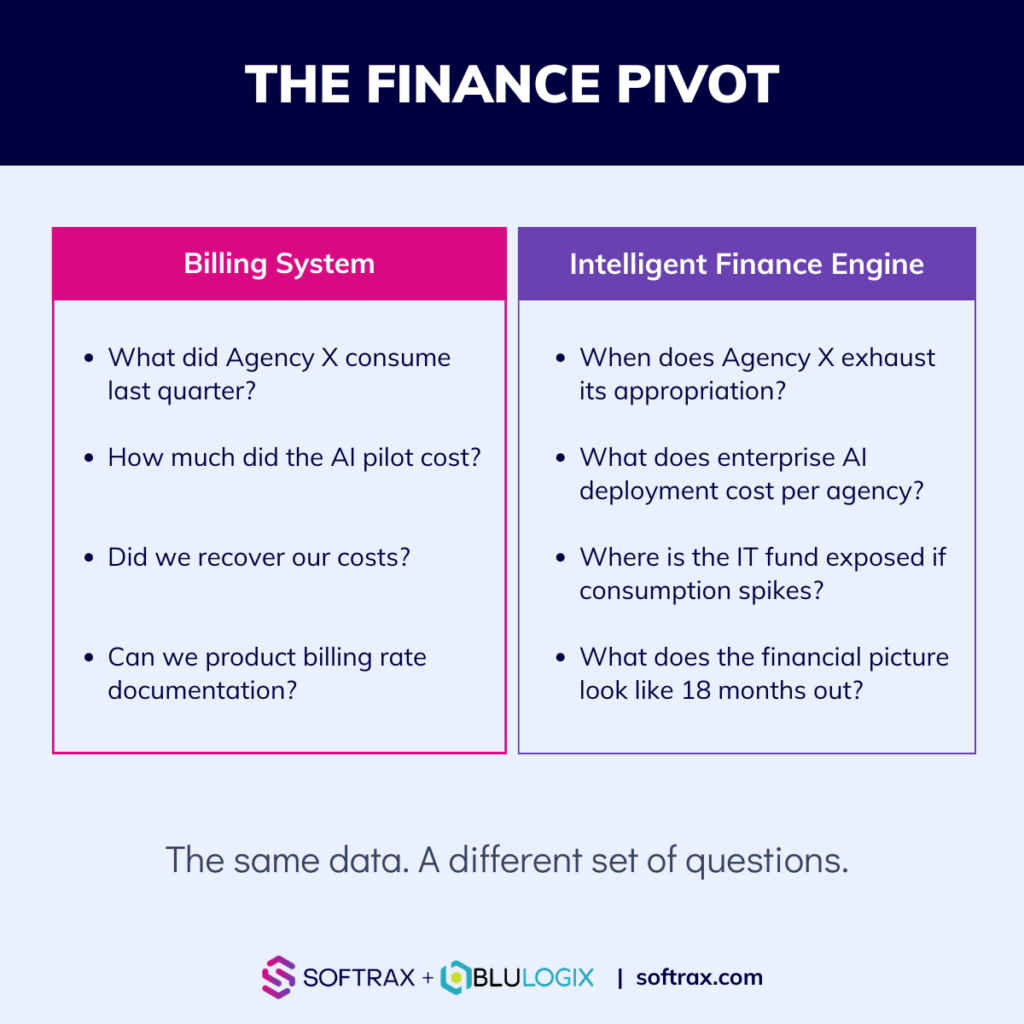
The same underlying data, organized to answer operational questions, is a billing system. That same data, organized to answer strategic questions, is something fundamentally different.
The same data. A different set of questions.
Not “what did Agency X consume last quarter?” but “at the current burn rate, when does Agency X exhaust its appropriation, and which services are driving the acceleration?”
Not “how much did the AI pilot cost?” but “at this cost-per-token rate, what does enterprise deployment look like across a dozen agencies, and which ones have the budget to sustain it?”
Not “did we recover our costs?” but “where is the IT fund structurally exposed if consumption spikes, and what does the financial picture look like eighteen months out?”
These are not operational questions. They are strategic ones. And they are only answerable if the underlying data is clean, current, and connected to budget actuals in real time.
Automating the billing layer is not about reducing headcount. It is about unlocking capacity for higher-value work.
Right now, in most states, a meaningful portion of finance staff time goes toward manual reconciliation: chasing usage records, matching invoices to interagency agreements, and defending spreadsheets. These are not high-leverage activities. They are the overhead costs of a billing system that was never built to run at this scale.
When that overhead is automated, the team’s capacity is redirected. Not eliminated. The finance team that spent half its month reconciling invoices can now monitor burn rates against appropriations, flag programs approaching budget ceilings, model the financial implications of technology investment decisions, and provide real-time financial context alongside the CIO’s team. That is the strategic work. The billing foundation is what makes it possible.
At the NASCIO Midyear Conference, Tennessee’s CIO Jerry Jones described the broader transition underway in state technology: the shift from systems of record to systems that act. It was a precise observation about AI and automation, but it applies equally to financial infrastructure.
A billing system is a system of record. It captures what happened. An intelligent finance engine is a system that acts: it monitors what is happening, projects where it is heading, and gives the people responsible for state technology dollars the information they need to make decisions in time to matter.
The billing foundation has to hold. But the reason to build it right is not the invoice. The reason is what the invoice enables.
Part Four of this series examines how states are approaching governance of AI spending: as workloads scale, what does responsible financial oversight of technology investment actually look like, and who in the organization owns it?
This is part three of a five-part series, “The Invisible Deficit,” examining revenue leakage in state government cloud and AI billing. The series draws on NASCIO research, state IT strategic plans, and conversations with state technology and finance leaders.
Dave Mink works at the intersection of public sector technology and financial operations.




| Cookie | Duration | Description |
|---|---|---|
| cookielawinfo-checbox-analytics | 11 months | This cookie is set by GDPR Cookie Consent plugin. The cookie is used to store the user consent for the cookies in the category "Analytics". |
| cookielawinfo-checbox-functional | 11 months | The cookie is set by GDPR cookie consent to record the user consent for the cookies in the category "Functional". |
| cookielawinfo-checbox-others | 11 months | This cookie is set by GDPR Cookie Consent plugin. The cookie is used to store the user consent for the cookies in the category "Other. |
| cookielawinfo-checkbox-necessary | 11 months | This cookie is set by GDPR Cookie Consent plugin. The cookies is used to store the user consent for the cookies in the category "Necessary". |
| cookielawinfo-checkbox-performance | 11 months | This cookie is set by GDPR Cookie Consent plugin. The cookie is used to store the user consent for the cookies in the category "Performance". |
| viewed_cookie_policy | 11 months | The cookie is set by the GDPR Cookie Consent plugin and is used to store whether or not user has consented to the use of cookies. It does not store any personal data. |