









By David Mink, Director of Public Sector, SOFTRAX + BluLogix 

When the Bill Arrives, the Problem Has Already Happened: State Government Cloud Allocation and the Spike Problem

State governments are paying their cloud bills on time. That is not the problem. The problem arrives three weeks later, when central IT has to explain to an agency why their budget absorbed a cost they did not cause, cannot verify, and whose fiscal window has already closed.

This is Part 2 of The Invisible Deficit — a look at the specific moment where the billing gap opens widest.

One deadline. Three agencies. One bill.

Every spring, state tax filing portals absorb a predictable surge. Citizens file in the final days before the deadline. Traffic spikes. Compute scales. The cloud vendor bills. Central IT pays.

So far, no problem.

The problem is what happens next. A tax filing deadline touches the Department of Revenue processing returns, the Labor agency handling wage filings, and Treasury managing payment reconciliation. Three agencies. One deadline. One invoice with thousands of usage records formatted for the vendor, not for the state’s interagency billing system.

A billing analyst sits down to reconcile. The clock is running.

The cloud bill is not the problem. Attribution is.

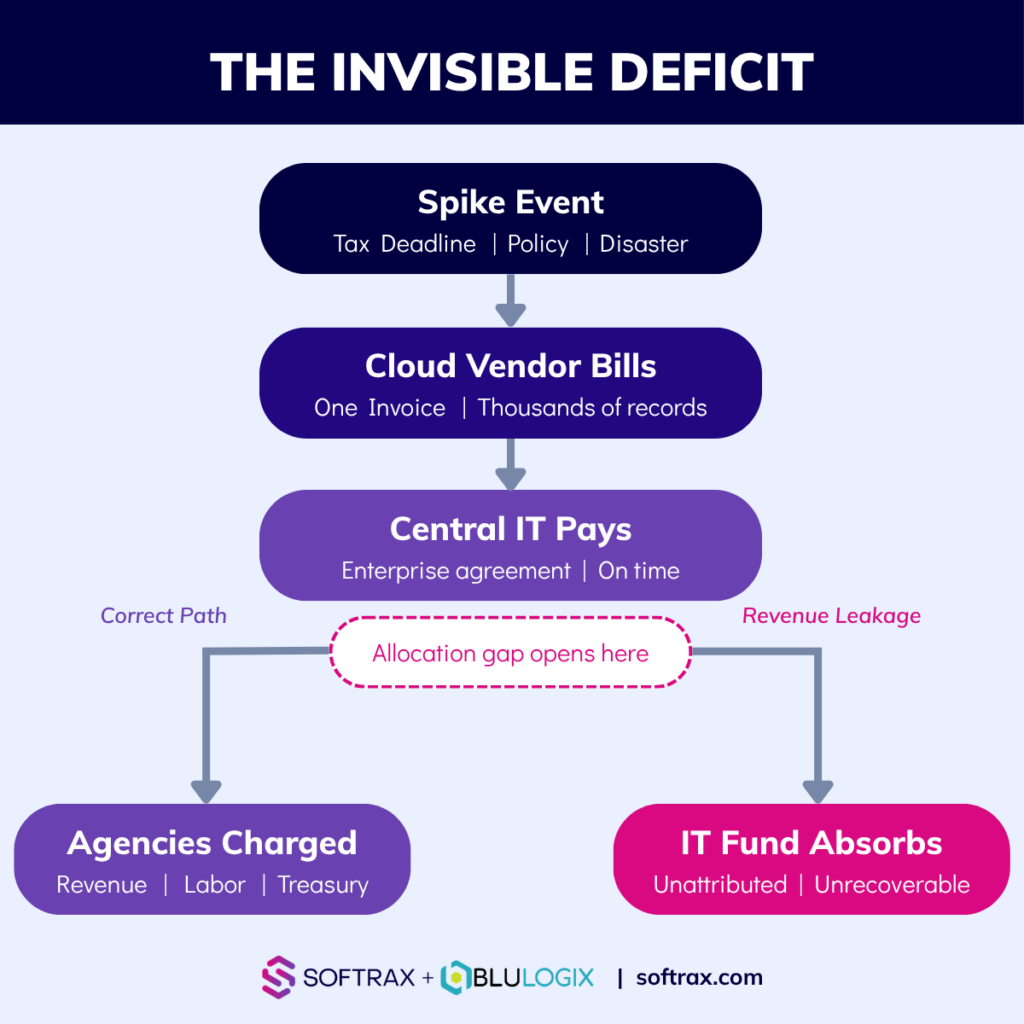
Most states operate enterprise cloud agreements with committed spending. The vendor gets paid regardless of consumption fluctuations. What the agreement does not solve is the internal question of which agency drove which portion of the spike.

At normal volume, this is manageable. Analysts know the patterns. But a spike changes everything. Volumes are higher. Records multiply. Patterns disappear. Error rates climb even when effort and experience remain constant.

Invisible Deficit Diagram

An agency gets charged for consumption that was not theirs. Another agency’s usage gets absorbed by the IT fund because it could not be attributed in time. By the time anyone notices, the fiscal period has closed.

The money is gone. Not because it was spent. Because it was not recovered.

Why fixing it later does not work

Operating appropriations lapse at fiscal year-end. An interagency billing adjustment requires both agencies to have open appropriations. In a biennial budget state, correcting a prior-period error may require a formal process longer than the fiscal window allows.

The spike happened. The vendor was paid. The IT fund absorbed what could not be attributed. That absorption carries into the next year as an unexplained variance on no one’s dashboard.

Part 3 examines what happens when it is not one filing deadline. When multiple agencies spike simultaneously because of something no one planned for. That is where manual reconciliation does not just stretch. It breaks.

Dave Mink works at the intersection of public sector technology and financial operations.

Learn how SOFTRAX + BluLogix helps state IT organizations track and recover cloud and AI spending.

We Are Attending Channel Partners Conference & Expo 2026
April 13-16, 2026 | Las Vegas, NV | Booth #2454